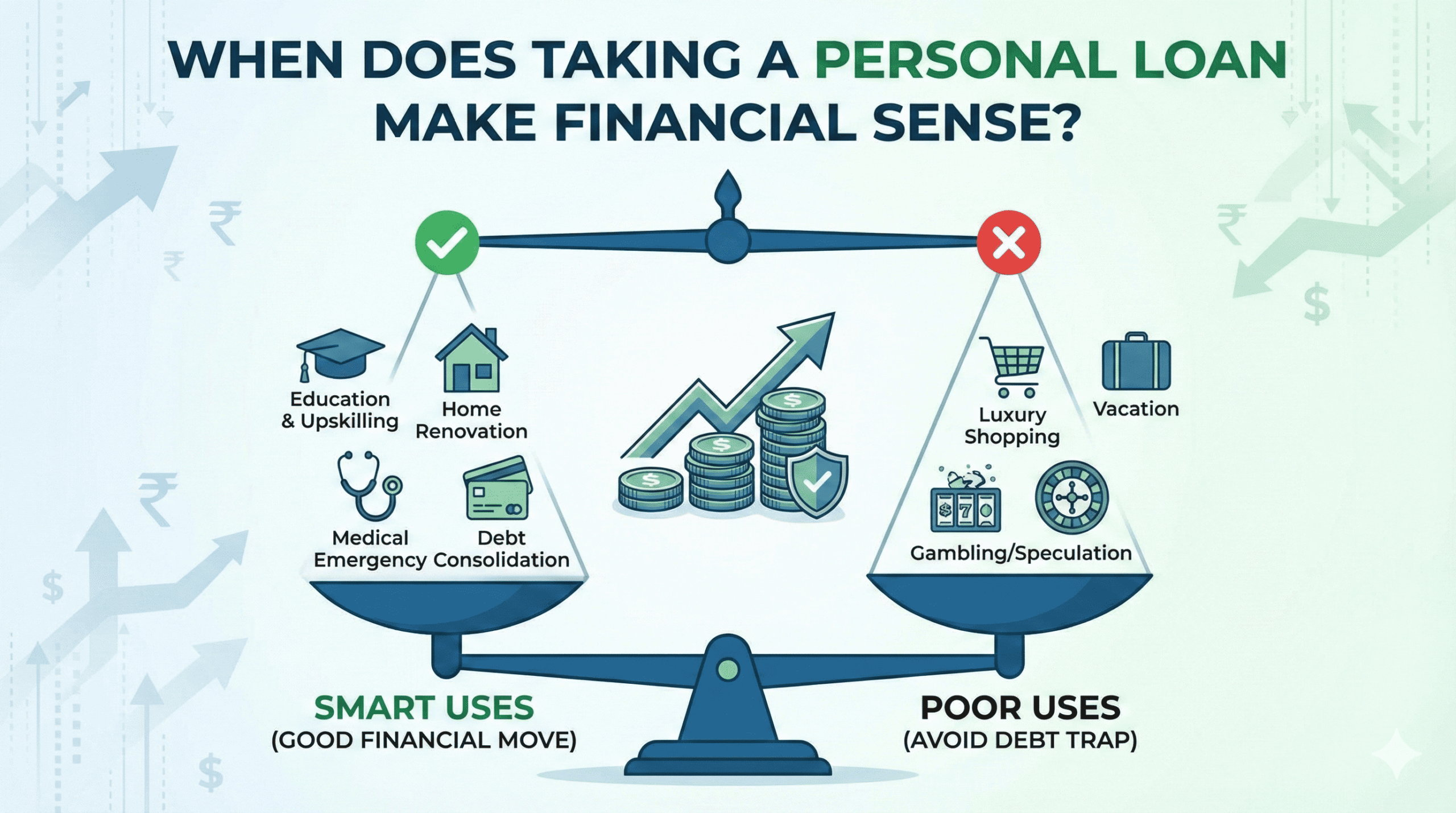
Taking a personal loan makes financial sense when it addresses a genuine need and does not create long-term financial stress. The decision should be driven by necessity rather than convenience, and supported by clear repayment strategy and stable income. Understanding when personal loans work for you versus against you is crucial for maintaining financial health while leveraging credit as a useful tool rather than a dangerous trap.
Personal loans make sense for genuine emergencies that cannot wait for savings accumulation. Medical emergencies requiring immediate treatment, urgent home repairs affecting safety or livability, or sudden family obligations where delay causes significant harm are valid scenarios. In these situations, the cost of not having funds immediately outweighs the interest cost of borrowing. However, even here, the loan amount should be limited to the actual emergency need, not padded for comfort or unrelated expenses.
Debt consolidation represents another financially sound use case when executed correctly. If you’re carrying multiple high-interest debts—particularly credit card balances charging 36-42% annually—consolidating them into a single personal loan at 14-18% dramatically reduces interest burden and simplifies repayment. For example, ₹3 lakhs across three credit cards at average 38% interest costs approximately ₹1,14,000 annually in interest alone. Consolidating to a personal loan at 15% reduces this to ₹45,000, saving ₹69,000 yearly. However, consolidation only works if you stop accumulating new credit card debt—many borrowers consolidate, feel relieved, resume spending on cards, and end up with both loan EMI and new card debt, worsening their position.
Significant life events like weddings, where costs are substantial and delay isn’t feasible, can justify personal loans when family savings fall short. However, this requires honest assessment of affordable borrowing limits. Taking a ₹10 lakh loan to fund an extravagant wedding when your income supports only ₹5 lakh comfortably means starting married life under severe financial stress. The right approach involves using savings for the bulk of expenses and borrowing only the gap amount that can be repaid within 2-3 years without straining monthly budgets.
Income stability stands as the foundational criterion for all personal loan decisions. Personal loan EMIs should fit comfortably within monthly expenses, leaving room for savings and unexpected costs. A common rule suggests keeping total EMIs (across all loans) below 40-50% of net monthly income. If you earn ₹50,000 monthly and already have ₹15,000 in existing EMIs, adding another ₹12,000 personal loan EMI pushes your total to ₹27,000 (54% of income), leaving only ₹23,000 for rent, food, utilities, transport, insurance, and savings. This creates a fragile situation where any income disruption or unexpected expense triggers a crisis.
Personal loans can make sense for income-generating investments, though this requires careful analysis. Borrowing to purchase equipment that demonstrably increases business revenue, or for professional certification that leads to salary increases, can generate returns exceeding borrowing costs. For instance, a freelancer borrowing ₹2 lakhs at 16% to purchase professional equipment that increases monthly income by ₹8,000 pays ₹4,600 monthly EMI for 4 years but gains ₹8,000 monthly—a net gain of ₹3,400 monthly after EMI payment. However, this only works when the income increase is certain and sustainable, not speculative.
Situations where personal loans rarely make financial sense include routine lifestyle spending, discretionary purchases that can be delayed, and recurring expenses that should be covered by monthly income. Borrowing for vacations, gadgets, fashion, dining, or entertainment creates a troubling pattern where EMIs outlast the enjoyment or utility derived from the expense. A ₹2 lakh vacation loan taken in January means paying ₹4,600 monthly for 4 years—you’re still paying for that vacation in January four years later when the memories have faded but the financial burden remains.
Using personal loans for investments in equities, cryptocurrencies, or speculative ventures is particularly risky. Borrowed money comes with guaranteed interest costs, while investment returns are uncertain. If investments underperform or lose value, you’re still obligated to pay EMIs from your income, potentially forcing you to sell investments at losses to meet loan obligations. The psychological stress of servicing debt while watching investments decline amplifies poor decision-making.
Before taking any personal loan, honest evaluation of alternatives is essential. Have you exhausted your emergency fund? Can you delay the expense and save for it? Can you cut discretionary spending to accumulate the needed amount faster? Are there lower-cost borrowing options like gold loans, loans against fixed deposits, or even borrowing from family without interest? Could selling assets or liquidating investments be a better alternative than high-interest borrowing? These questions force discipline and ensure borrowing is truly the optimal choice rather than the easiest one.
The tenure decision significantly impacts whether a personal loan makes financial sense. Shorter tenures mean higher EMIs but dramatically lower total interest cost and faster debt freedom. If you can afford a 3-year tenure but choose 5 years for lower EMI, you pay significantly more interest and remain debt-obligated for two additional years. Those extra years reduce your financial flexibility for other goals and opportunities. The right tenure balances affordable EMI with minimum reasonable duration.
Personal loans make sense when they solve real problems, fit within comfortable repayment capacity, serve as temporary bridges rather than permanent crutches, and come with clear payoff strategies. They become risky when used for wants disguised as needs, when EMI strain requires lifestyle compromises, when borrowed to service other debts without addressing root spending issues, or when taken without contingency planning for income disruptions. The difference between personal loans working for you versus against you lies entirely in the honest assessment of need, realistic evaluation of repayment capacity, and disciplined execution of the borrowing and repayment plan.
Leave a Reply