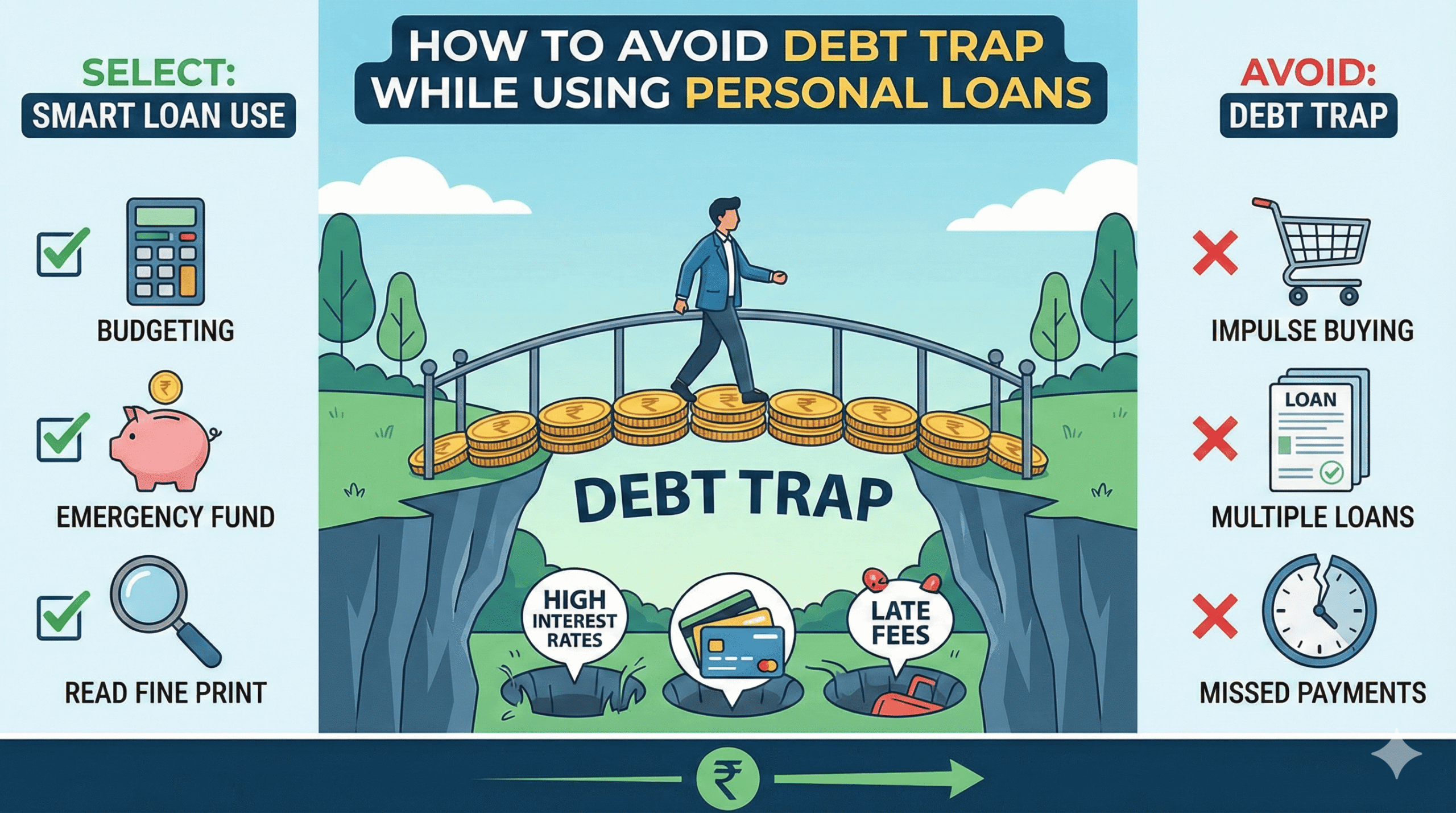
A debt trap occurs when borrowed money and its associated obligations become self-perpetuating, requiring additional borrowing to service existing debt, ultimately creating an unsustainable cycle that compromises financial stability and long-term wellbeing. Personal loans, with their easy accessibility and minimal documentation requirements, particularly in the digital lending era, pose significant debt trap risks when used without discipline and planning. Avoiding this trap requires understanding the psychological and structural mechanisms that create debt dependency, implementing strict borrowing discipline, and maintaining constant vigilance over your overall financial health.
The debt trap cycle typically begins innocuously. You take a personal loan for a seemingly valid reason—wedding expenses, home renovation, or even debt consolidation. The EMI feels manageable initially, fitting within your budget with some adjustments to discretionary spending. However, several months into repayment, an unexpected expense arises—medical emergency, vehicle repair, or family obligation. Having committed most spare income to the existing EMI, you lack savings to handle this new need. The easy solution appears to be another personal loan. This second loan adds to your EMI burden, further reducing financial flexibility. When the next unexpected need arises—and it inevitably will—you’re even less equipped to handle it from income or savings, necessitating a third loan. Each iteration reduces your financial breathing room until you’re taking new loans primarily to service existing obligations rather than for genuine new needs.
The fundamental principle for avoiding debt traps is borrowing only for genuine needs, never for discretionary wants. Genuine needs include unavoidable medical emergencies where delay risks health outcomes, urgent home repairs affecting safety or habitability, or debt consolidation that demonstrably reduces total interest burden. Discretionary wants include vacations, lifestyle upgrades, gadgets, fashion, entertainment, or expenses that can be delayed until you save for them. The psychological challenge is that we’re adept at reframing wants as needs—’I need this vacation to avoid burnout,’ ‘I need this gadget for productivity.’ Honest evaluation requires asking: ‘What happens if I don’t have this immediately? Can I delay and save for it? Is this expense recurring or one-time?’ If answers reveal the expense can be delayed or managed through savings, borrowing creates unnecessary debt.
Borrow only amounts you can comfortably repay within the shortest reasonable tenure. The affordability test isn’t whether you qualify for a loan amount, but whether the EMI fits within 25-30% of your net monthly income while leaving room for essential expenses, savings, and emergency buffers. If your monthly income is ₹60,000, limit total EMIs across all loans to ₹18,000-₹24,000, not the ₹30,000-₹36,000 that lenders might approve using their 50-60% FOIR models. Lenders maximize approvals to maximize lending; your responsibility is setting conservative limits based on realistic cash flow assessment that accounts for income variability, expense inflation, and life uncertainties.
Tenure selection critically impacts debt trap risk. Longer tenures appear attractive because they minimize monthly EMI, making loans feel affordable. However, extended tenures dramatically increase total interest costs and keep you debt-obligated for many years, reducing financial flexibility throughout. More dangerously, long tenures normalize debt as a permanent state rather than a temporary bridge. Someone perpetually servicing 5-7 year loans, taking new loans as old ones close, never experiences debt-free financial breathing room. This psychological normalization makes additional borrowing feel acceptable rather than concerning. Choose the shortest tenure where EMI remains comfortably affordable—typically 2-4 years for most personal loans. This creates urgency to clear debt quickly and limits the total interest burden.
Never use personal loans to service other debts without addressing root causes. Debt consolidation makes sense when replacing high-interest credit card debt (36-42% annually) with lower-interest personal loans (14-18%), provided you stop accumulating new credit card debt. The trap occurs when borrowers consolidate, feel relieved, resume credit card spending, and end up with both loan EMI and new card debt within months. This pattern—borrow to pay debt, accumulate new debt, borrow again to pay combined debt—creates an accelerating spiral. Before consolidating, honestly assess: ‘Why did I accumulate this debt? Have I addressed the spending behaviors that created it? Do I have a plan to prevent recurrence?’ Without behavioral changes, consolidation simply delays inevitable crisis while adding more debt.
Maintain an emergency fund equivalent to 6-12 months of essential expenses before taking personal loans. The absence of emergency reserves is the single biggest factor pushing borrowers into debt traps. When unexpected expenses arise without emergency funds, borrowing becomes the only option. With adequate reserves, most emergencies can be handled from savings, eliminating the need for additional loans. Building emergency funds while servicing existing loans is challenging but essential—even ₹2,000-₹3,000 monthly saved in a liquid fund creates buffers that prevent future borrowing. Consider emergency fund building as non-negotiable as EMI payment.
Monitor your total debt-to-income ratio continuously. Calculate this monthly by dividing all EMI obligations by net monthly income. When this ratio exceeds 40%, you’re entering dangerous territory. Above 50%, you’re in a debt trap or approaching one rapidly. At these levels, any income disruption—salary delay, bonus cancellation, job loss—immediately triggers crisis. Most importantly, ratios above 40% make lenders wary of additional lending, meaning if genuine emergencies arise, you may not qualify for help precisely when you need it most. If your ratio exceeds 40%, make debt reduction your top financial priority—suspend all discretionary spending, use bonuses entirely for debt prepayment, and avoid any new borrowing.
Avoid taking multiple personal loans simultaneously. Each additional loan incrementally reduces financial flexibility, but more importantly, multiple loans indicate concerning financial patterns. Lenders view multiple concurrent personal loans as a red flag suggesting financial stress. The cumulative effect of multiple processing fees, interest charges, and EMI obligations is far worse than a single larger loan. If you have existing loans and new needs arise, explore whether your current lender offers top-up loans at better terms than new separate loans.
Never borrow for recurring expenses or routine lifestyle spending. Personal loans should finance one-time expenses or investments that don’t recur monthly. Borrowing for rent, monthly shopping, utility bills, entertainment, or regular dining out indicates fundamental income-expense mismatch. These recurring needs will exist next month and the month after; borrowing to fund them this month just shifts the problem forward while adding interest costs. Address recurring shortfalls through income increases (additional work, side gigs, career advancement) or expense reduction, never through borrowing.
Implement the prepayment discipline. Whenever you receive bonuses, tax refunds, gift money, or any windfall, allocate at least 50% toward loan prepayment. This systematically reduces outstanding principal, lowers total interest costs, and accelerates debt freedom. Prepaying even ₹25,000-₹50,000 annually on a ₹5 lakh loan can reduce tenure by 12-18 months and save ₹40,000-₹60,000 in interest. More importantly, it creates positive momentum toward debt freedom rather than normalization of perpetual debt.
Recognize warning signs of approaching debt traps: using credit cards extensively to manage monthly expenses because EMIs consume most income; frequently checking loan eligibility on multiple websites; calculating how much additional EMI you could afford if you cut essential expenses; delaying essential expenses or savings contributions to ensure EMI payment; feeling stressed about upcoming EMI dates consistently; considering loans to pay other loans; or having multiple loan applications rejected. Any of these signals require immediate intervention—financial counseling, income increase efforts, aggressive expense reduction, and complete cessation of new borrowing.
Finally, educate yourself continuously about healthy debt management and personal finance. Understanding concepts like effective interest rates, debt-to-income ratios, emergency fund adequacy, and long-term financial planning builds resistance to the easy credit temptation. Follow reputable personal finance resources, consider consulting fee-only financial advisors (not commission-based ones who profit from selling products), and participate in financial literacy programs. Avoiding debt traps isn’t about never using personal loans—it’s about using them strategically for genuine needs, within comfortable affordability limits, with clear repayment plans, while maintaining emergency reserves and honest assessment of your financial capacity and behavioral patterns.
Leave a Reply