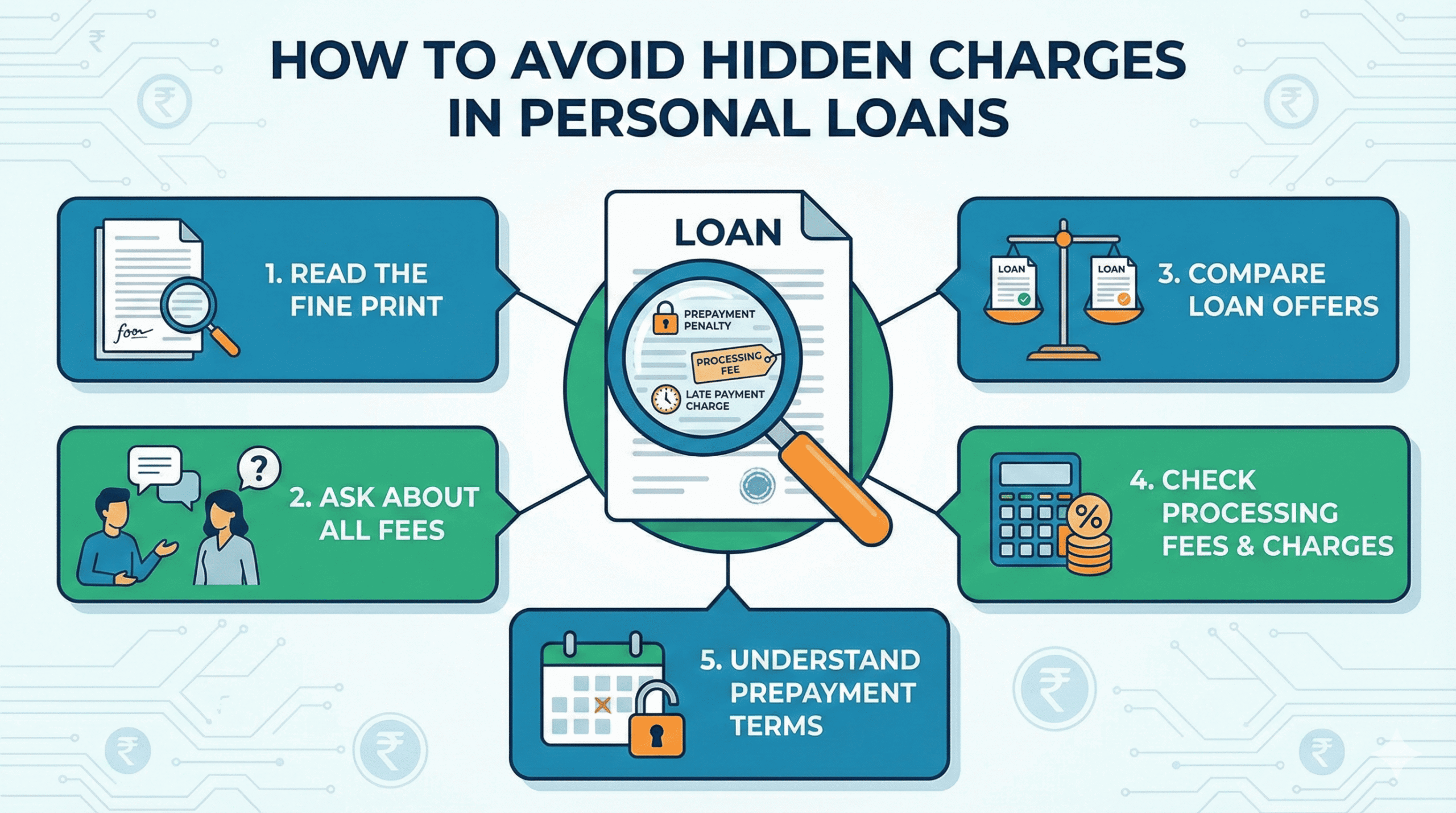
Hidden charges in personal loans can transform what appears to be an affordable borrowing option into an expensive financial burden. These charges rarely appear in prominent marketing materials or loan advertisements; instead, they’re buried in fine print, loan agreements, and terms and conditions documents that most borrowers skim or skip entirely. The cumulative impact of hidden charges can increase your effective interest rate by 2-3 percentage points annually, costing you tens of thousands of rupees over the loan tenure. Avoiding these charges requires vigilance, detailed document review, and asking the right questions before accepting loan offers.
The most significant hidden cost is often the processing fee structure. While lenders disclose processing fees, the deceptive practice lies in how they’re presented. A lender might advertise ‘1% processing fee’ which sounds minimal—on a ₹5 lakh loan, that’s ₹5,000. However, the fine print reveals 18% GST is added on top, making it ₹5,900. Some lenders then add documentation charges, technical evaluation fees, or administrative charges separately, pushing the total upfront cost to ₹8,000-₹12,000. More deceptively, some lenders deduct processing fees from the disbursed amount rather than collecting separately. You’re sanctioned ₹5 lakhs but receive only ₹4,88,200 in your account, yet you must repay ₹5 lakhs plus interest. This effectively increases your real borrowing cost since you’re paying interest on money you never received.
Prepayment and foreclosure charges represent another category where borrowers discover costs only when attempting early repayment. The loan agreement might state ‘prepayment allowed after 12 months’ but omit the charge until you review the detailed fee schedule buried on page 15. These charges typically range from 2-5% of the outstanding principal amount. On a loan with ₹3 lakhs outstanding, 4% foreclosure charge means paying ₹12,000 just to close your debt early—a penalty for being financially responsible. Some lenders structure this as ‘prepayment allowed only twice per year with 3% charge per instance,’ limiting your flexibility even further. Always ask explicitly: ‘What are the exact prepayment charges, under what conditions do they apply, and are there any restrictions on prepayment frequency or amount?’
Late payment penalties operate on multi-layered structures that maximize lender revenue. The visible charge is typically ₹500-₹1,000 per delayed EMI, which most borrowers know. The hidden element is penal interest—usually 2-4% per month (24-48% annually) on the overdue amount. If your ₹12,000 EMI is 15 days late, you might pay ₹750 fixed penalty plus (₹12,000 × 3% ÷ 2) = ₹180 penal interest, totaling ₹930 for a two-week delay. More insidiously, some lenders compound penal interest, and the late payment gets reported to credit bureaus after 30 days, causing credit score damage worth far more than the monetary penalty. The compound hidden cost—monetary penalty, penal interest, credit score damage, and future borrowing cost increases—can exceed ₹50,000 over time from a single missed payment.
Cheque bounce or mandate failure charges often surprise borrowers. When your EMI auto-debit fails due to insufficient funds, lenders charge ₹500-₹750 per failed attempt. The hidden aspect is that lenders may automatically re-present the mandate 2-3 times over subsequent days, each time levying charges. A single cash flow mismatch can result in 3 failed attempts = ₹2,250 in charges, plus penal interest, plus late payment reporting. Some lenders charge separate NACH mandate registration fees (₹300-₹500) which isn’t disclosed in the main fee structure.
Insurance bundling is a sophisticated hidden charge mechanism. Many lenders offer—or automatically include—credit life insurance or credit shield insurance that covers loan repayment if you die, become disabled, or lose employment. While potentially valuable, this insurance adds 0.5-1% to your annual loan cost. On a ₹5 lakh loan, this means ₹2,500-₹5,000 annually, or ₹12,500-₹25,000 over a 5-year tenure. The deceptive practice lies in how it’s presented: insurance is often pre-selected in online applications, mentioned casually during branch applications, or bundled into the EMI amount without separate line-item disclosure. Critically, this insurance is almost always optional—you can decline it—but lenders rarely volunteer this information. Always ask: ‘Is any insurance included in this loan, what does it cost, and can I opt out?’
Switching or balance transfer charges catch borrowers seeking better terms. After a year of paying high interest, you find another lender offering 2% lower rates and decide to transfer your loan. Your current lender then discloses foreclosure charges (3-5% of outstanding principal), while the new lender charges processing fees (1-2% of transfer amount), and sometimes a separate balance transfer fee. The combined charges can exceed ₹25,000 on a ₹5 lakh transfer, requiring you to calculate whether the interest savings over remaining tenure justify these upfront costs.
Statement and certificate charges represent minor but irritating hidden costs. Lenders may charge ₹100-₹300 for duplicate statements, ₹500-₹1,000 for loan closure certificates or NOC certificates, ₹200-₹500 for interest certificates needed for tax filing, and ₹100-₹250 per physical statement. While individually small, these charges accumulate and indicate lender attitudes toward customer service. Progressive lenders provide all documentation digitally at no cost.
Legal, stamp duty, and documentation charges vary by state and lender. Stamp duty on loan agreements ranges from ₹500-₹5,000 depending on state and loan amount. Legal charges for agreement drafting might add ₹1,000-₹3,000. Some lenders absorb these costs while others pass them to borrowers without clear disclosure. Always ask for an exhaustive list of all one-time charges beyond processing fees.
To systematically avoid hidden charges, implement this verification process: First, request a complete fee schedule in writing before accepting any loan offer. Don’t rely on verbal assurances or prominent marketing materials. Ask for a document listing every possible charge—processing, documentation, prepayment, late payment, mandate failure, certificate issuance, insurance, and any others. Second, read the entire loan agreement before signing, particularly sections titled ‘Fees and Charges,’ ‘Prepayment Terms,’ ‘Default and Consequences,’ and ‘Insurance.’ Use a highlighter to mark every mention of charges and create a list. Third, ask explicit questions about any charges you don’t understand: ‘Under what circumstances would I be charged this? Is this mandatory or optional? Are there any conditions or exceptions?’ Fourth, compare the total cost across lenders using a comprehensive model that includes all charges, not just interest rates. Fifth, negotiate—especially if you’re a strong borrower, many charges are negotiable. Processing fees can sometimes be reduced from 2% to 1%, prepayment charges waived entirely, or insurance made optional.
Choose lenders with transparent fee structures and strong customer service reputations. Digital fintech lenders often have simpler, more transparent fee structures with fewer hidden charges compared to traditional institutions with legacy systems and revenue models dependent on fee income. Read recent customer reviews specifically mentioning unexpected charges or poor disclosure practices. Finally, maintain meticulous records of all loan documents, fee schedules, and communications—if disputes arise about undisclosed charges, documentation provides protection. Avoiding hidden charges in personal loans isn’t about finding a lender with zero fees—it’s about ensuring complete transparency so you can make informed decisions based on total true cost rather than being surprised by charges that emerge only after you’ve committed.
Leave a Reply