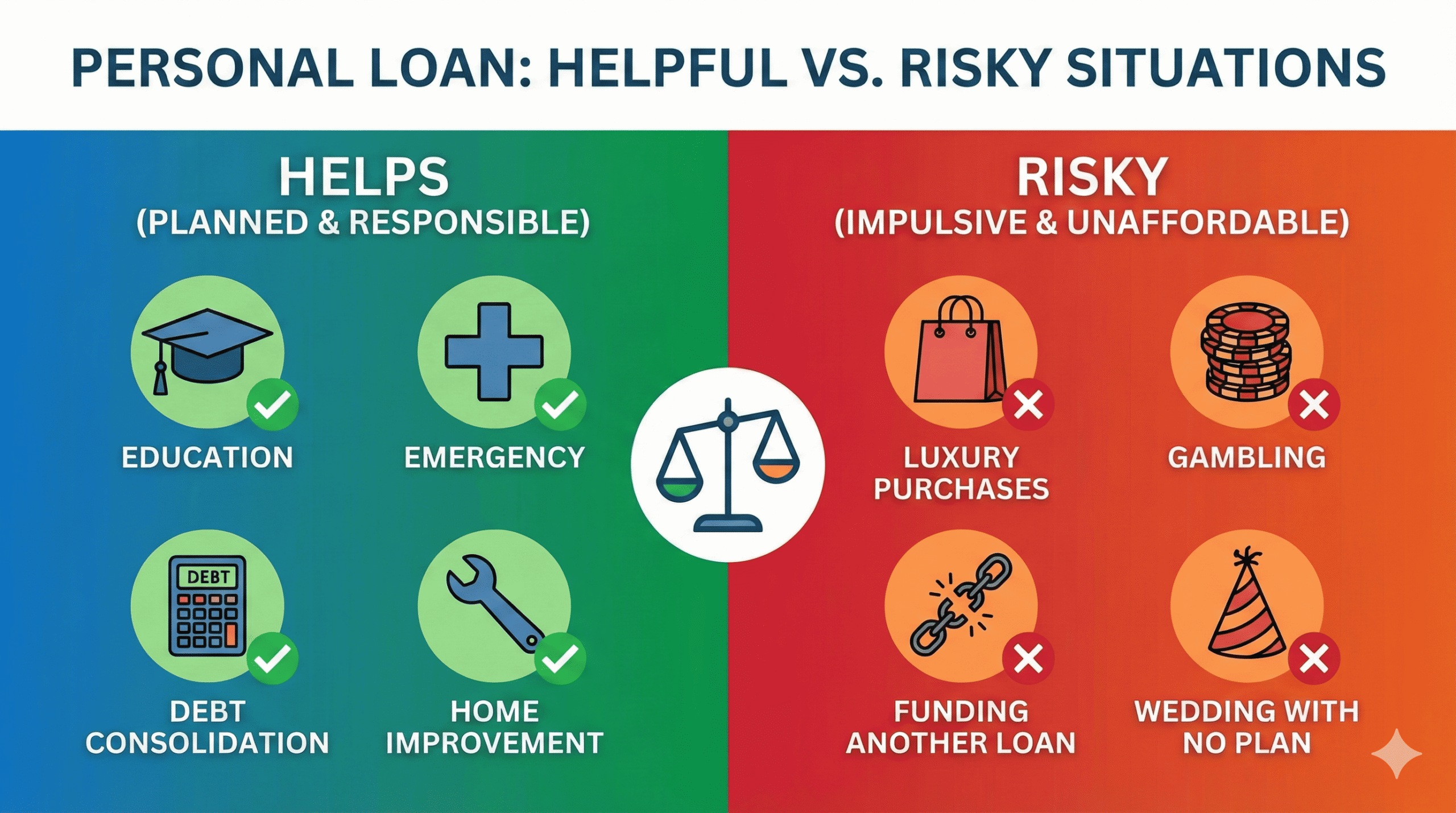
Personal loans represent a double-edged financial instrument—capable of providing crucial support during genuine need while simultaneously possessing the potential to trap borrowers in long-term financial stress. The outcome depends entirely on the circumstances of borrowing, the borrower’s financial discipline, and realistic assessment of repayment capacity. Understanding the clear distinction between helpful and risky personal loan scenarios empowers borrowers to make informed decisions that enhance rather than compromise financial stability.
Personal loans help meaningfully when deployed for unavoidable expenses where delay causes greater harm than the cost of borrowing. Medical emergencies requiring immediate treatment represent the quintessential helpful scenario. When health is at stake and insurance coverage falls short, accessing funds quickly through a personal loan can be literally life-saving. The interest cost becomes secondary to the primary benefit of timely treatment. Similarly, urgent home repairs affecting structural safety, water damage requiring immediate remediation, or critical appliance replacement fall into this category where delay exacerbates problems and costs.
Debt consolidation executed properly represents another genuinely helpful application. Borrowers carrying multiple credit card balances at 36-42% annual interest face a crushing burden where minimum payments barely cover interest, allowing principal to remain perpetually outstanding. Consolidating ₹5 lakhs of credit card debt at average 38% interest into a personal loan at 15% reduces annual interest from ₹1,90,000 to ₹75,000—a savings of ₹1,15,000 yearly. More importantly, the fixed EMI structure creates clear payoff timeline, replacing the endless cycle of minimum payments. However, the critical condition for this to help rather than harm is complete cessation of credit card debt accumulation post-consolidation.
Income-generating investments occasionally justify personal loans when return certainty is high. A small business owner borrowing ₹3 lakhs at 16% to purchase equipment demonstrably increasing monthly revenue by ₹12,000 pays approximately ₹6,900 monthly EMI but gains ₹12,000 monthly income—net benefit of ₹5,100 monthly after servicing the loan. Professional certifications or education leading to confirmed salary increases follow similar logic. However, the returns must be near-certain and sustainable, not speculative or hopeful.
Significant life events like weddings or childbirth sometimes necessitate borrowing when family savings prove insufficient and the event cannot be delayed. In these scenarios, personal loans help bridge the gap between available resources and necessary expenses. The key distinction is borrowing for necessary components versus borrowing to fund extravagance. Borrowing ₹2 lakhs to cover essential wedding expenses when you have ₹5 lakhs saved differs dramatically from borrowing ₹10 lakhs to fund an elaborate celebration beyond your means.
Risk escalates dramatically when personal loans are taken for discretionary lifestyle spending. Borrowing for vacations, luxury purchases, gadgets, or entertainment creates a toxic pattern where debt obligations outlive the utility or enjoyment derived. A ₹3 lakh loan for a luxury vacation means paying approximately ₹6,900 monthly EMI for 5 years—you’re still servicing that vacation debt long after photos have faded from social media feeds. This transforms what should be a joyful experience into a long-term financial burden accompanied by regret.
Taking personal loans when already carrying substantial existing debt amplifies risk exponentially. Each new loan reduces financial flexibility and increases the probability of eventual default. If existing EMIs already consume 40% of income, adding another personal loan pushes the ratio to dangerous levels where any income disruption—salary delay, bonus cancellation, medical expense—triggers immediate crisis. Financial advisors warn against layering unsecured debt; the compounding effect of multiple loans creates situations where borrowers become trapped servicing debt with no capacity for savings, investments, or emergency buffers.
Long tenure selections increase risk substantially despite appearing comfortable initially. A 7-year personal loan tenure might reduce monthly EMI by 40% compared to a 3-year tenure, making it feel more affordable. However, this comfort is illusory. The total interest paid nearly doubles, you remain debt-obligated for four additional years, and your financial flexibility for other life goals—buying property, starting a family, changing careers—remains constrained throughout. Moreover, income stability over 7 years is far less predictable than over 3 years; life circumstances change, creating situations where what seemed affordable becomes burdensome.
Borrowing without honestly assessing repayment capacity represents the most fundamental risk factor. Many borrowers focus exclusively on whether they qualify for a loan amount, ignoring whether they should take it. Lenders approve loans based on mathematical formulas and credit scores, but they don’t understand your complete financial picture—upcoming expenses, family obligations, career stability, health concerns, or personal financial goals. Just because a lender approves ₹8 lakhs doesn’t mean borrowing that amount is prudent. Conservative self-assessment of sustainable EMI, accounting for worst-case scenarios like temporary income loss, prevents over-borrowing that seems manageable during good times but becomes crushing during challenges.
Using personal loans to service other debts without addressing underlying spending issues is perhaps the riskiest pattern. Borrowers take personal loans to pay credit card bills, then resume credit card spending, then take another personal loan to consolidate the new card debt plus the existing personal loan—a debt spiral that accelerates until collapse. This pattern indicates fundamental spending discipline issues that borrowing cannot solve; it merely delays inevitable reckoning while compounding the problem with interest costs.
Employment instability or irregular income dramatically elevates personal loan risk. Salaried employees in established companies with stable income can predict cash flows and commit to fixed EMI obligations with reasonable confidence. Self-employed individuals, freelancers, or those in volatile industries face income uncertainty that makes fixed debt obligations risky. A profitable quarter feels manageable, but subsequent lean months create immediate stress. For borrowers with irregular income, maintaining larger emergency reserves before taking loans is essential, and choosing shorter tenures despite higher EMIs provides faster debt escape if circumstances deteriorate.
Age and life stage influence risk profiles significantly. Borrowers in their 20s and 30s with long earning years ahead can absorb longer tenures with lower risk than those in their 50s approaching retirement. A 55-year-old taking a 7-year personal loan faces the reality of servicing debt into retirement years when income drops substantially. Similarly, borrowers planning major life changes—marriage, parenthood, career shifts, relocation—face elevated risk from personal loan obligations that reduce flexibility precisely when flexibility is most valuable.
The distinction between helpful and risky personal loans ultimately reduces to honest evaluation of genuine need, realistic assessment of repayment capacity including adverse scenarios, clear distinction between wants and needs, and disciplined execution of repayment without accumulating additional debt. Personal loans help when they solve real problems without creating bigger ones. They become risky when used to fund lifestyle inflation, when layered onto existing debt burdens, when stretched over unreasonably long periods, or when taken without confronting underlying financial behavior issues. The loan itself is neutral; borrower circumstances and decisions determine whether it functions as a useful financial bridge or a dangerous trap leading to long-term financial stress.
Leave a Reply