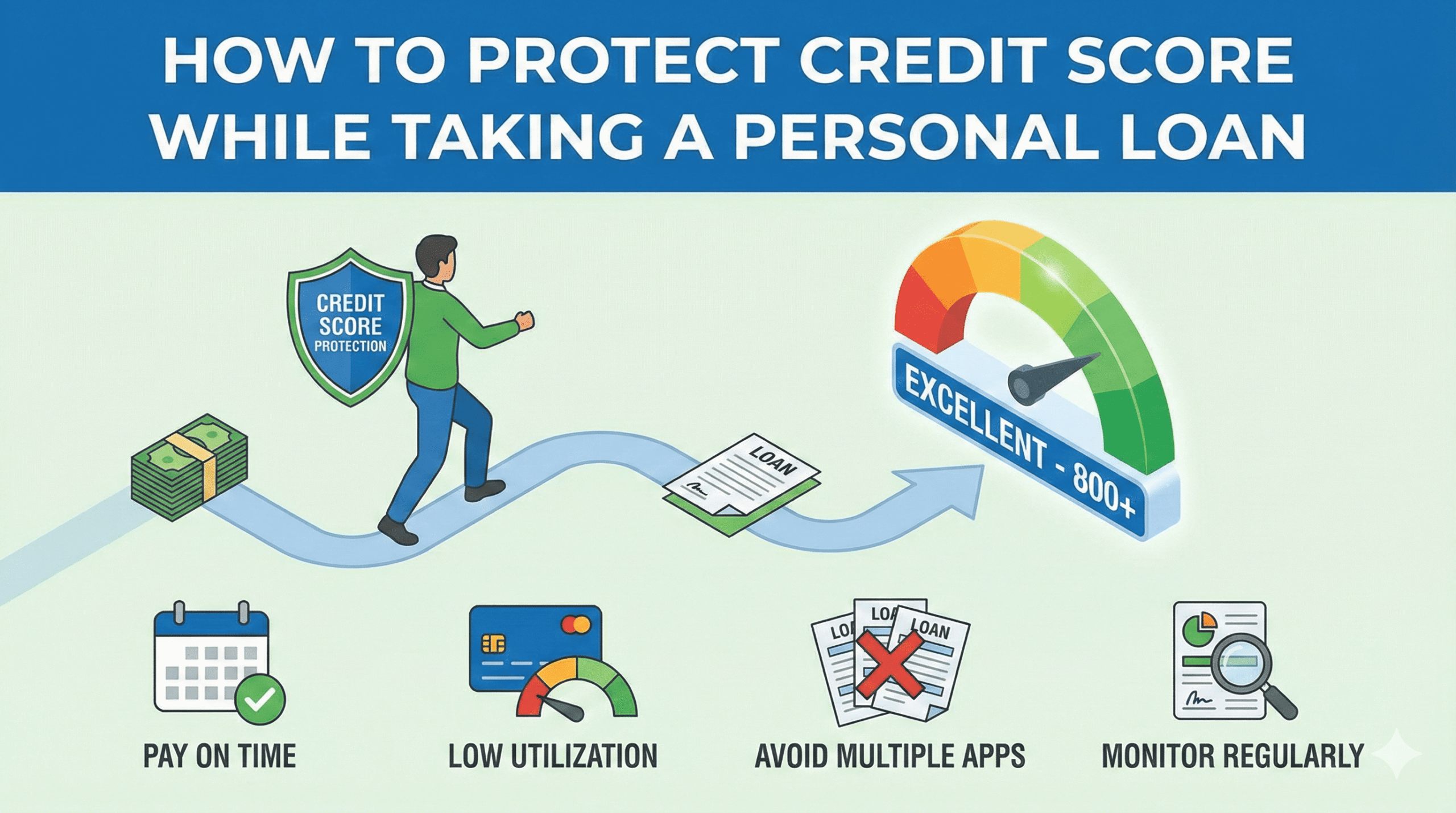
Your credit score functions as your financial reputation in numerical form, influencing not just loan approvals and interest rates but also credit card limits, rental applications, employment background checks, and even insurance premiums in some contexts. Personal loans create multiple touchpoints with your credit report—from initial application through monthly repayment behavior to eventual closure—each capable of either building or damaging your score. Protecting and ideally enhancing your credit score while using personal loans requires understanding credit scoring mechanics, implementing strategic behaviors, and avoiding common mistakes that cause lasting damage.
Credit scores in India are calculated by four bureaus—CIBIL, Experian, Equifax, and CRIF High Mark—using similar but not identical methodologies. CIBIL scores range from 300-900, with 750+ considered excellent, 700-750 good, 650-700 fair, and below 650 poor. The score derives from five primary factors: payment history (35% weight), credit utilization (30%), credit history length (15%), credit mix (10%), and recent credit inquiries (10%). Personal loans impact each of these factors differently, creating opportunities for score improvement when managed well and risks of damage when handled poorly.
The first credit score impact occurs during application—the hard inquiry. When you formally apply for a personal loan, lenders request your credit report from one or more bureaus, triggering a ‘hard inquiry’ that gets recorded. Each hard inquiry temporarily reduces your score by 5-10 points and remains visible on your report for 2 years, though the impact diminishes after a few months. A single inquiry has minimal effect, but multiple inquiries within short periods signal credit hunger or financial distress to lenders, potentially triggering rejections. The critical strategy is consolidating credit shopping into compressed timeframes. Credit scoring models recognize that consumers shop for best rates and typically count multiple inquiries for the same loan type within 14-45 days as a single inquiry. Therefore, do all your research and applications within a 2-week window rather than spreading them over months.
Before applying anywhere, use pre-qualification tools and eligibility calculators offered by most lenders. These typically perform ‘soft inquiries’ that don’t impact your score, giving you a realistic assessment of approval chances. Only proceed to formal applications with lenders where pre-qualification indicates high approval probability. This prevents accumulating multiple hard inquiries from rejected applications—rejection hurts both through the inquiry itself and the signal it sends to subsequent lenders who see the rejection on your report.
Once your loan is approved and disbursed, the loan account appears on your credit report with details including loan type (personal loan), account opening date, loan amount, tenure, EMI amount, and current status. This new account affects your credit mix and total debt burden. Initially, this might cause a minor score dip—your total debt has increased, and your debt-to-income ratio has worsened. However, this initial dip is temporary and recovers quickly with responsible repayment behavior.
Payment history constitutes 35% of your credit score, making it the single most influential factor. Every month, your lender reports whether your EMI was paid on time, delayed, or missed. On-time payments are reported as ‘XXX’ on CIBIL reports (X = paid as agreed) and gradually build your score. Even a single 30-day delay gets reported as ’30 DPD’ (days past due) and drops your score by 50-100 points. Multiple delays, 60+ day delays, or defaults create increasingly severe damage. The critical protection strategy is ensuring 100% on-time payment throughout the loan tenure. Implement multiple safeguards: set up auto-debit mandate (NACH) for automatic EMI deduction; maintain sufficient balance in your account 3-5 days before EMI due date; set up multiple reminders—calendar alerts 5 days before, 3 days before, and 1 day before EMI date; consider creating a dedicated sub-account that automatically transfers your EMI amount right after salary credit. Never rely on memory alone; life gets busy, and a forgotten EMI payment can cost you 100+ credit score points.
Credit utilization, though typically associated with credit cards, extends to installment loans as well. Your total outstanding debt across all loans impacts how lenders perceive your financial burden. Keeping your outstanding loan balances decreasing through regular payments signals responsible debt management. Conversely, taking additional loans while existing ones remain outstanding increases your total utilization and can depress scores. The protection strategy involves avoiding multiple simultaneous loans when possible and using prepayment to accelerate principal reduction. Each prepayment reduces your outstanding balance, improving your credit utilization ratio.
Loan tenure completion and closure significantly boost credit scores when handled properly. Successfully repaying a loan to completion demonstrates credit responsibility and gets marked as ‘Closed’ on your report. This closed account with perfect payment history remains on your report for 7 years, continuously contributing positive credit history. However, the closure must be handled correctly. After making your final EMI or foreclosure payment, verify within 45-60 days that your credit report shows the loan as ‘Closed’ with zero outstanding balance. Errors are common—loans showing as ‘Active’ despite being paid off, showing outstanding balances, or worst case, showing as ‘Settled’ instead of ‘Closed.’ ‘Settled’ status occurs when lenders agree to accept less than full dues and indicates financial distress, severely damaging scores. Always ensure proper ‘Closed’ status by obtaining loan closure certificates from lenders and checking credit reports for accurate reflection.
Avoid settlement or default at all costs. If you face genuine repayment difficulties, communicate proactively with lenders to explore restructuring options, EMI deferment, or tenure extensions rather than defaulting. Default leads to cascading damage: your account gets marked as NPA (Non-Performing Asset) after 90 days past due, your score crashes below 600, you get classified as a defaulter for 7 years on credit reports, future lending becomes nearly impossible, and lenders may initiate legal proceedings. Recovery from default takes years; prevention through proactive communication is infinitely preferable.
Monitor your credit reports regularly throughout the loan tenure. Check all four bureau reports (CIBIL, Experian, Equifax, CRIF High Mark) every quarter—you’re entitled to one free report annually from each bureau, and paid monitoring services cost ₹500-₹1,000 annually but provide valuable regular visibility. Monitoring helps you catch errors early—lenders sometimes report late payments incorrectly, show wrong outstanding amounts, or fail to update closures. When you identify errors, immediately raise disputes with the credit bureau through their online portals, providing supporting documentation like payment receipts or bank statements. Bureaus typically resolve disputes within 30 days, but undetected errors can damage your score for years.
Be strategic about loan closure timing if you plan multiple credit applications. Your credit report shows various accounts and their ages. Closing your oldest accounts can reduce your average account age, slightly impacting scores. If your personal loan is one of your older credit accounts and you’re planning to apply for a home loan or vehicle loan soon, consider whether closing it immediately before that major application might marginally reduce your score at a critical time. This is a minor consideration—never keep debt active just to maintain account age—but timing loan closure a few months before or after major credit applications can optimize your score at critical moments.
Understand the positive aspects of personal loans for credit building. If your credit mix consists only of credit cards (revolving credit), adding an installment loan like a personal loan diversifies your credit mix, which comprises 10% of your score. Successfully managing both revolving and installment credit demonstrates broader credit management capability. Additionally, if you’re recovering from past credit mistakes and rebuilding your score, a small personal loan managed perfectly for 12-24 months can accelerate score improvement by adding positive payment history.
Never apply for multiple credit products simultaneously. If you take a personal loan and immediately apply for credit cards or other loans, the multiple hard inquiries compound, and lenders see simultaneous debt accumulation as risky behavior. Space out credit applications by at least 3-6 months when possible. If you need multiple products, prioritize—get the most important one first, ensure it’s reporting positively for a few months, then apply for others.
Maintain low balances on other revolving credit while servicing your personal loan. Your total debt burden across all credit types affects scoring. If you’re paying personal loan EMI while maximizing credit card limits, your overall credit utilization appears unhealthy. Keep credit card balances below 30% of limits, ideally below 10%, even while servicing personal loan EMI. This demonstrates that you’re managing the personal loan obligation without overstretching on other credit lines.
Finally, maintain realistic expectations about credit score movement. Taking a personal loan might initially drop your score by 10-30 points due to the hard inquiry, new debt, and increased utilization. This is normal and temporary. With consistent on-time payments over 3-6 months, your score not only recovers but exceeds the pre-loan level. By loan completion, borrowers who made perfect payments typically see score increases of 50-100 points compared to before the loan. Protecting your credit score while using personal loans isn’t about avoiding score drops entirely—it’s about managing the loan responsibly so the long-term trajectory is upward, transforming the personal loan from a potential credit risk into a credit-building opportunity.
Leave a Reply