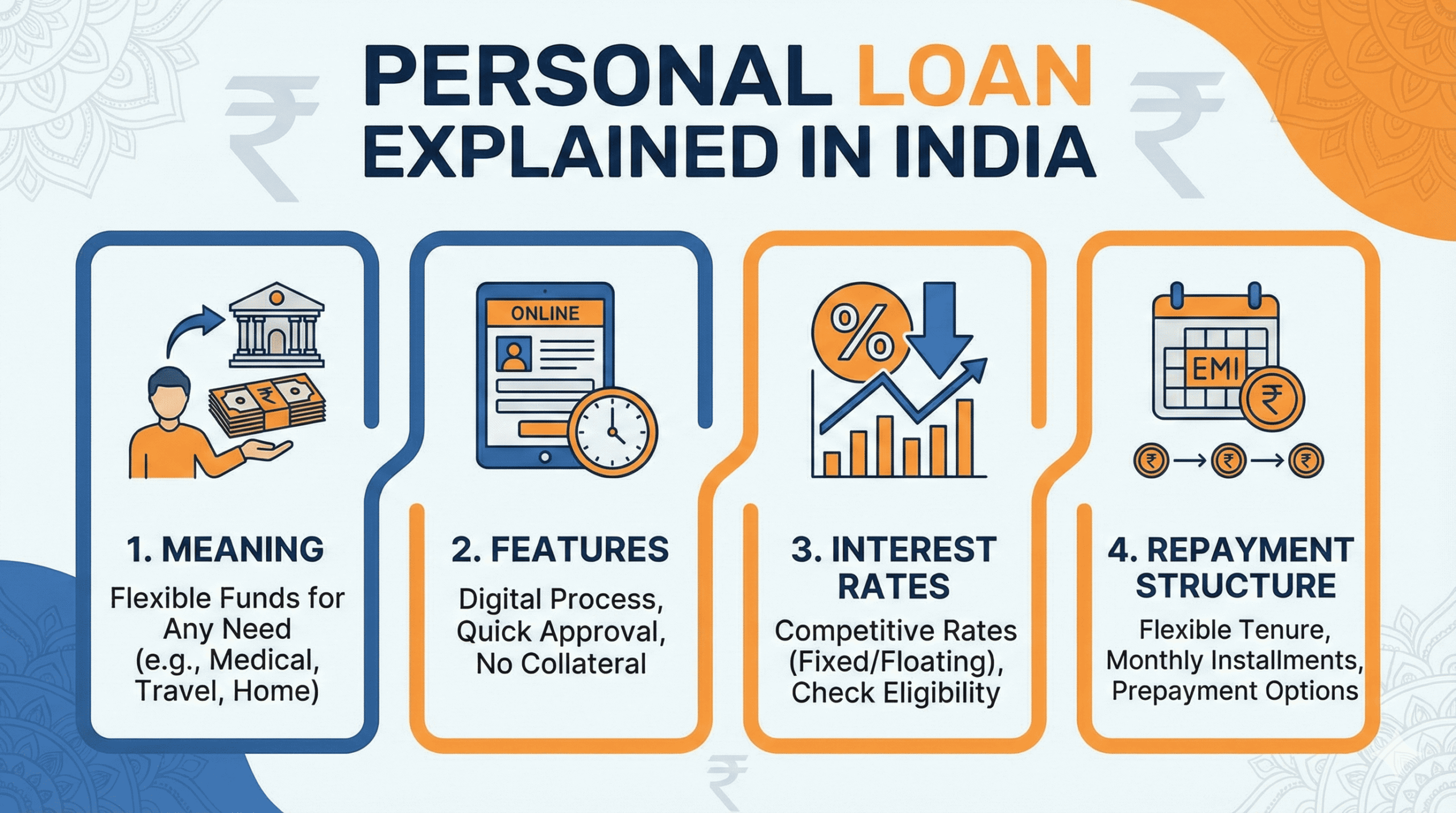
A personal loan in India is an unsecured credit facility that allows individuals to borrow money without pledging any collateral such as property, gold, or vehicles. Unlike secured loans, approval depends primarily on income stability, credit history, employment type, and demonstrated repayment capacity. This flexibility makes personal loans accessible to salaried employees, self-employed professionals, and business owners who may not own significant assets but demonstrate stable income streams.
The fundamental appeal of personal loans lies in their unrestricted end-use flexibility. Whether you need funds for medical emergencies, wedding expenses, home renovation, debt consolidation, education costs, or travel, personal loans provide financial support without requiring detailed justification. Loan amounts typically range from ₹50,000 to ₹40 lakhs, depending on income profile and lender policies. This stands in contrast to purpose-specific loans like home loans or vehicle loans, where borrowed amounts must be used only for the stated purpose.
However, this flexibility comes at a premium cost. The unsecured nature fundamentally alters the risk equation for lenders. When banks disburse home loans, they hold property as security. With personal loans, lenders rely entirely on the borrower’s promise to repay, backed only by legal recourse and credit bureau reporting. This elevated risk translates into higher interest rates, typically ranging from 10.50% to 24% per annum in the Indian market as of 2024-2025.
Interest rate determination involves sophisticated assessment of multiple factors. Credit score remains the most influential variable—a CIBIL score above 750 can secure rates 4-6 percentage points lower than someone with a 650 score. Employment stability matters significantly; individuals working in government sectors, PSUs, or large corporations often receive preferential rates compared to those in startups or contractual roles. Monthly income and existing EMI obligations determine disposable income available for repayment, with most lenders ensuring total EMIs don’t exceed 50-60% of net monthly income.
Beyond the interest rate, the true cost includes several additional charges. Processing fees typically range from 1% to 3% of the loan amount—on a ₹5 lakh loan, this means ₹5,000 to ₹15,000 upfront, plus 18% GST. Prepayment or foreclosure charges are critical to understand; many lenders allow prepayment after 6-12 months but levy charges ranging from 2-5% of outstanding principal. Some modern digital lenders have eliminated prepayment charges, making them attractive for borrowers anticipating early closure. Late payment penalties, typically ₹500-₹1,000 per instance plus penal interest of 2-3% per month, can quickly accumulate if EMI due dates are missed.
The repayment structure follows the Equated Monthly Installment (EMI) model, where each payment comprises both principal and interest components. The interest component dominates during initial years, gradually decreasing as principal gets paid down. This front-loaded structure means closing a 5-year loan after 2 years still results in paying a disproportionately large share of total interest.
Tenure selection represents one of the most critical decisions, yet it’s often driven by wrong considerations. Many borrowers select the longest tenure to minimize monthly EMI, ignoring the dramatic increase in total interest paid. Consider a ₹5 lakh loan at 14% annual interest: a 3-year tenure results in EMI of approximately ₹17,100 with total interest of ₹1,15,700, while a 5-year tenure reduces EMI to ₹11,630 but increases total interest to ₹1,97,800—a difference exceeding ₹82,000. The optimal approach involves choosing the shortest tenure that maintains EMI below 30% of net monthly income while preserving an emergency buffer.
Credit score impact cannot be overstated. Every loan application triggers a hard inquiry, temporarily reducing your score. Once sanctioned, repayment behavior gets reported monthly. Consistent on-time payments can boost your score by 50-100 points over a year, while even a single 30-day delay can drop it by 50-100 points, impacting future borrowing for years.
Before approaching lenders, exploring alternatives often yields better outcomes. Building an emergency fund equivalent to 6-12 months of expenses can eliminate borrowing needs during most unforeseen situations. For planned expenses, systematic savings through SIPs or fixed deposits proves far more economical than paying 14-18% interest. Even within borrowing options, gold loans (8-12% interest) or loans against property (9-14%) may offer cheaper alternatives.
Personal loans serve legitimate purposes when used judiciously for genuine needs with clear repayment strategies. They provide quick liquidity during emergencies, help consolidate expensive debt, and enable important life events. However, treating them as easy money for lifestyle upgrades or impulse purchases transforms a useful tool into a long-term burden. Understanding every aspect—from interest calculation to credit score impact—empowers borrowers to make decisions supporting rather than compromising long-term financial health.
Leave a Reply