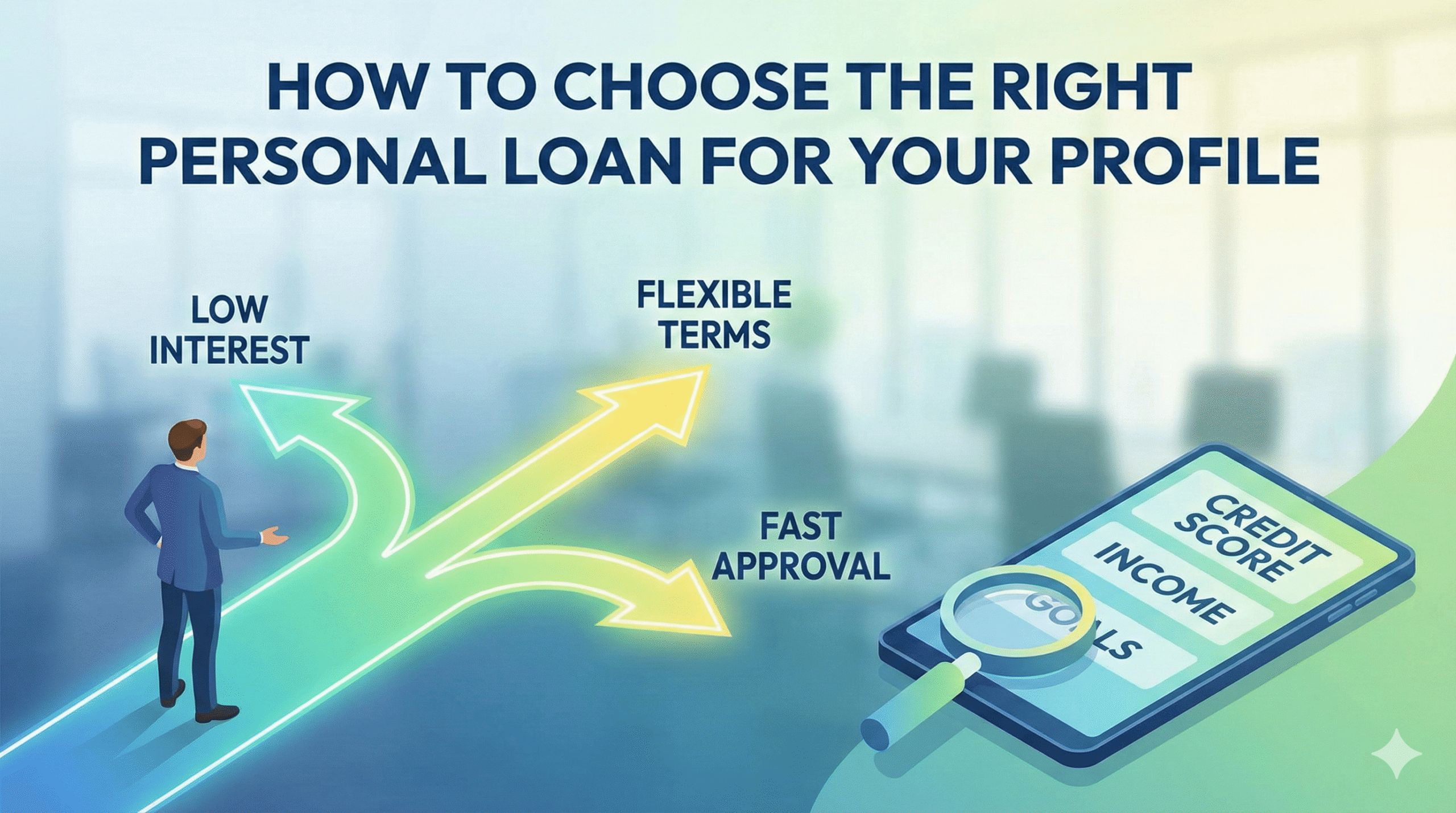
Choosing the right personal loan requires a strategic approach that goes far beyond accepting the first approval you receive. The Indian lending market offers dozens of options across public sector banks, private banks, NBFCs, and digital fintech lenders, each with distinct interest rates, eligibility criteria, processing speeds, and terms. Selecting the optimal loan for your specific profile can save lakhs of rupees in interest costs while ensuring comfortable repayment without financial strain.
The first critical step is honest self-assessment of your financial profile. Your credit score forms the foundation of your borrowing power—check it across all four bureaus (CIBIL, Experian, Equifax, CRIF High Mark) before starting applications. Scores above 750 qualify you for premium rates from top lenders, while scores between 650-750 limit options and increase costs. Below 650, you’ll face rejections from most mainstream lenders and should focus on credit repair before borrowing. Beyond credit score, evaluate your income stability—salaried employees in government, PSUs, or established corporations access better rates than those in startups or contractual roles. Self-employed individuals face more stringent documentation requirements and often higher rates due to perceived income variability.
Your existing debt burden critically determines both eligibility and the loan amount you should take. Calculate your current EMI-to-income ratio by dividing total existing EMIs by net monthly income. If this ratio already exceeds 40%, adding another personal loan creates dangerous financial stress. Most lenders use the Fixed Obligation to Income Ratio (FOIR) model, typically allowing 40-60% of income for all EMIs combined. For example, if your net monthly income is ₹75,000 and existing EMIs total ₹20,000, lenders using 50% FOIR will approve maximum EMI of ₹17,500 for a new loan [(75,000 × 50%) – 20,000]. At 14% interest over 4 years, this translates to approximately ₹7.5 lakhs maximum loan amount.
With your profile clearly understood, begin researching lender categories strategically. Public sector banks like SBI, Bank of Baroda, and Punjab National Bank typically offer the lowest interest rates (starting around 10.50-12%) but have stricter eligibility criteria, slower processing (7-15 days), and more documentation requirements. They work best for borrowers with excellent credit profiles, stable government or PSU employment, and patience for traditional processes. Private sector banks such as HDFC Bank, ICICI Bank, Axis Bank, and Kotak Mahindra balance competitive rates (11-16%) with superior customer service, faster processing (3-7 days), and modern digital interfaces. They represent the sweet spot for most urban salaried professionals.
NBFCs like Bajaj Finance, Tata Capital, Fullerton India, and Muthoot Finance occupy a unique position—they accept profiles that banks often reject, including those with slightly lower credit scores, self-employed individuals without extensive documentation, or those with limited banking relationships. However, this flexibility comes at a cost, with interest rates typically ranging from 13-20%. Digital fintech lenders such as Poonawalla Fincorp, MoneyTap, CASHe, and EarlySalary offer the fastest approvals (hours to 2 days) through completely digital processes and may eliminate prepayment penalties, but often charge effective interest rates exceeding 18-22% when all fees are included.
Comparing offers requires looking beyond advertised interest rates to calculate the true cost. Processing fees ranging from 1-3% plus GST significantly impact first-year costs. A loan advertised at 11.5% with 3% processing fee effectively costs 12.8% in year one. Prepayment charges are crucial if you anticipate bonuses or windfalls—many traditional lenders charge 2-5% of outstanding principal for early closure, while some modern lenders have eliminated this entirely. Late payment penalties varying from ₹500-₹1,000 plus 2-4% monthly penal interest matter for those with irregular cash flows. Tenure flexibility is important; some lenders offer only preset tenure options while others allow custom selection from 12-84 months.
Match lender strengths to your specific needs. For emergency medical expenses, prioritize digital lenders offering same-day disbursal despite higher costs—speed justifies the premium. For planned expenses like weddings where you have 2-3 weeks, traditional banks offering lower rates make sense. For debt consolidation, focus on lenders without prepayment penalties since you might close the loan early. For those with weak credit scores, NBFCs specializing in subprime lending may be your only option initially, but plan to refinance through balance transfer to better lenders once your score improves.
Leverage your existing banking relationships strategically. Your salary account bank already has your employment, income, and transaction history, often resulting in pre-approved offers at preferential rates with minimal documentation and fastest disbursal. These pre-approved offers, while convenient, should still be compared against market rates—sometimes loyalty doesn’t translate to best pricing. Credit card issuers often provide personal loan offers to customers with good repayment history, worth exploring if you’ve maintained cards well.
The application strategy matters significantly. Avoid shotgun approaches of applying to multiple lenders simultaneously—each application triggers a hard inquiry that temporarily drops your credit score by 5-10 points. Multiple inquiries within short periods signal credit desperation and can lead to rejections. Instead, use eligibility calculators and soft inquiry tools on lender websites to gauge approval chances before formal applications. Shortlist 2-3 lenders matching your profile, apply to your top choice first, and move to alternatives only if rejected.
Read loan agreement terms obsessively before accepting. Verify the interest rate type (fixed or floating), understand circumstances under which floating rates can change, confirm the exact EMI amount and due date, and scrutinize all fee clauses. Pay special attention to foreclosure terms, mandate failure charges, and dispute resolution mechanisms. Some agreements contain clauses allowing lenders to unilaterally change terms or charges—these should be questioned or avoided.
Finally, choose tenure wisely based on affordability, not just EMI minimization. While 7-year tenure might seem attractive due to lower monthly payments, it can double your total interest cost compared to 3-4 years. Select the shortest tenure where EMI stays comfortably below 30% of income, leaving room for savings and unexpected expenses. Choosing the right personal loan isn’t about finding the biggest amount or lowest EMI—it’s about matching loan terms to your financial profile, needs, and capacity in a way that solves your immediate requirement without compromising long-term financial health.
Leave a Reply