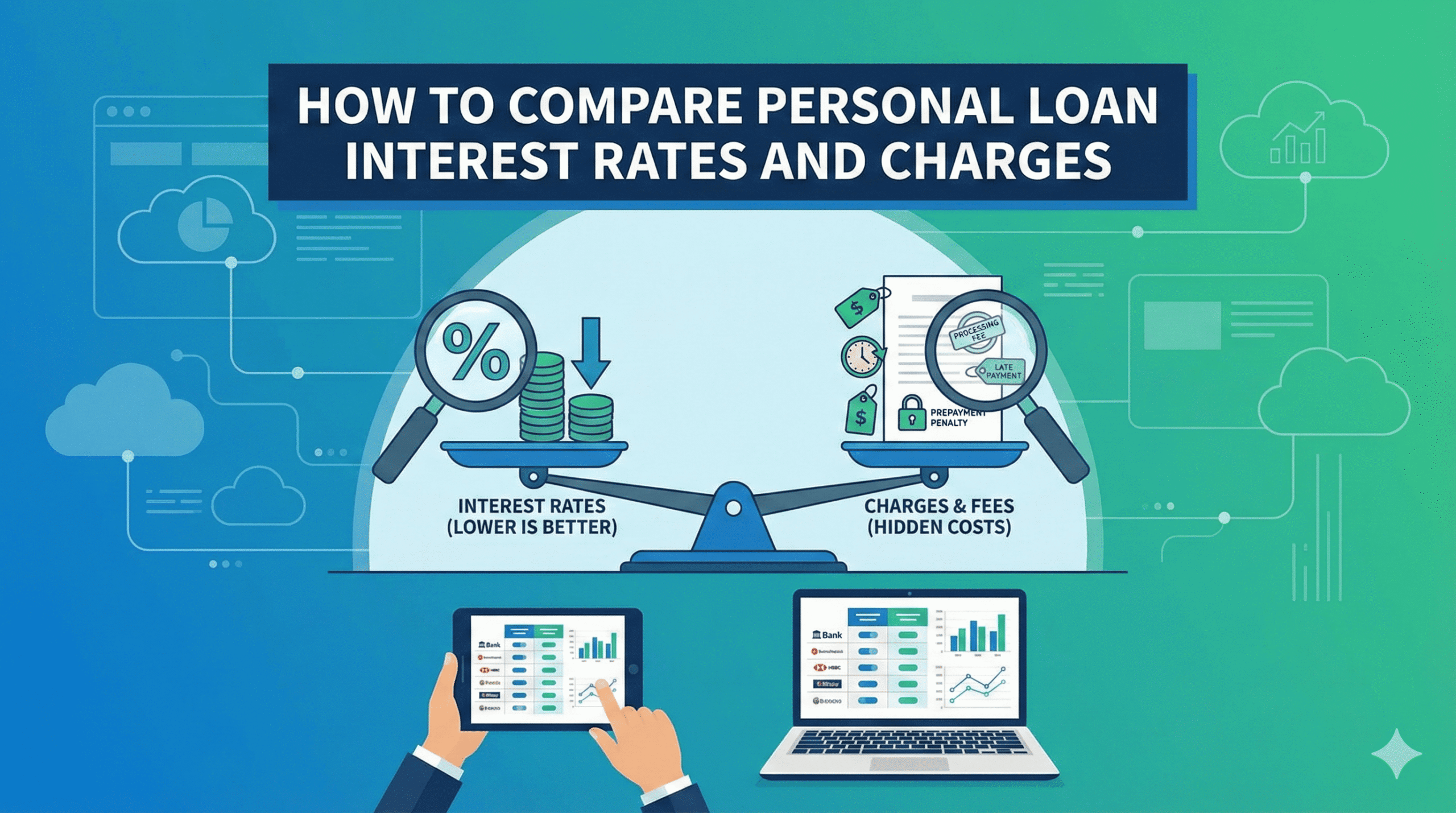
Comparing personal loan interest rates and charges requires looking far beyond the prominent percentage advertised in loan offers. Many borrowers make the costly mistake of selecting loans based solely on the stated interest rate, overlooking numerous additional charges that can increase the effective cost by 2-4 percentage points annually. A truly informed comparison involves calculating the total cost of borrowing across the entire tenure, understanding how different charge structures impact your actual outflow, and recognizing marketing tactics lenders use to make expensive loans appear cheaper.
Start by understanding that the advertised interest rate represents only the base cost of borrowing. Lenders quote annual percentage rates, but the critical question is whether this is a flat rate or reducing balance rate. Reducing balance (also called diminishing balance) is the standard and fair method where interest is calculated only on the outstanding principal each month—as you repay principal, interest charges decrease proportionally. Some unscrupulous lenders, particularly in the informal sector, quote flat rates where interest is calculated on the original principal throughout the tenure, effectively making the real interest rate nearly double the quoted rate. Always confirm the reducing balance method before proceeding.
Interest rates are never one-size-fits-all; they’re risk-based and personalized. The rate you receive depends on your credit score, income level, employment type, existing debt burden, and banking relationship. A lender might advertise ‘starting from 10.50%’ but that rate applies only to their lowest-risk customers with 780+ credit scores, high incomes, and government employment. Average borrowers with 700-750 scores might receive 14-16%, while those with 650-700 scores could face 18-20% from the same lender. When comparing lenders, request personalized rate quotes based on your actual profile rather than relying on advertised starting rates that you’re unlikely to receive.
Processing fees represent a significant upfront cost that dramatically impacts first-year expenses. These fees range from 1% to 3% of the loan amount plus 18% GST. On a ₹5 lakh loan, 2% processing fee plus GST equals approximately ₹11,800 deducted upfront. Some lenders deduct this from the disbursed amount—you receive ₹4,88,200 but must repay ₹5 lakhs—while others allow separate payment. This upfront charge effectively increases your first-year interest rate. Calculate the Annual Percentage Rate (APR) that includes processing fees: if you’re borrowing ₹5 lakhs at 14% interest with ₹11,800 processing fee, the effective first-year cost is approximately 16.4%. Many comparison websites ignore processing fees, making expensive loans appear competitive.
Prepayment and foreclosure charges critically affect total cost and flexibility. Traditional lenders often charge 2-5% of outstanding principal if you close the loan before tenure completion. On a ₹5 lakh loan with ₹3 lakhs outstanding, 4% foreclosure charge means paying ₹12,000 just for the privilege of clearing your debt early. This effectively traps you in expensive loans even when you have funds to close them. Progressive lenders, particularly digital fintech companies and some private banks, have eliminated prepayment charges entirely, providing valuable flexibility. When comparing loans, explicitly ask about prepayment terms—the answer can swing your decision if you anticipate bonuses or windfalls during the tenure.
Late payment penalties deserve careful scrutiny despite hopes you’ll never need this information. Life happens—salary delays, forgotten due dates, or cash flow mismatches can cause EMI failures. Penalties typically include a fixed charge (₹500-₹1,000 per instance) plus penal interest (2-4% per month on the overdue amount). More importantly, late payments get reported to credit bureaus after 30 days, damaging your score by 50-100 points. Compare lenders on their late payment policies—some offer grace periods of 3-5 days, others report immediately. Some charge ₹500 while others charge ₹1,500. For borrowers with irregular cash flows, lenient late payment terms provide valuable protection.
Cheque bounce or mandate failure charges apply when your EMI auto-debit fails due to insufficient funds. Charges range from ₹500-₹750 per failed attempt, and lenders may re-present the mandate multiple times, multiplying charges. Some lenders charge mandate registration fees separately. Understanding these charges matters for those with tight monthly cash flows where timing mismatches between salary credit and EMI debit can occur.
Hidden charges often lurk in fine print. Some lenders charge annual loan maintenance fees of ₹500-₹1,500, documentation charges beyond processing fees, charges for duplicate statements or certificates, and even charges for paying EMI through certain channels (branch payment fees). Credit life insurance or job loss insurance is sometimes bundled into loans, adding 0.5-1% to the total cost annually—you can usually opt out, but lenders rarely highlight this. Legal and stamp duty charges, though nominal (₹500-₹2,000), vary by state and should be confirmed upfront.
To conduct effective comparison, create a standardized comparison spreadsheet. For each lender, list the personalized interest rate quoted for your profile, processing fee as both absolute amount and percentage, prepayment charges (percentage and conditions), late payment penalty structure, mandate failure charges, any recurring annual fees, and insurance costs if applicable. Calculate the total amount payable over the full tenure for identical loan amounts and tenures across lenders—this single figure reflects true total cost better than any individual parameter.
Calculate EMI using standard formulas or online calculators, then multiply EMI by total number of months and add all upfront charges to derive total outflow. For example, ₹5 lakhs at 14% for 4 years means EMI of approximately ₹13,610, total repayment of ₹6,53,280, plus processing fee of ₹11,800, totaling ₹6,65,080. Compare this total across lenders—sometimes a loan at 13.5% with 3% processing fee and 4% prepayment charge costs more over 3 years than a loan at 14% with 1% processing fee and no prepayment charge, especially if you plan to prepay.
Use Annual Percentage Rate (APR) as the equalizer metric. APR incorporates interest rate and all fees into a single percentage that reflects true annual cost. Many international lenders quote APR by default; Indian lenders rarely do, but you can calculate it or use online APR calculators. A loan advertised at 11% interest with 2.5% processing fee and various other charges might have an APR of 12.8-13.2%, revealing its true cost.
Consider the tenure impact when comparing. A lender offering lower interest but only long tenure options (5-7 years) might cost more in total interest than a higher-rate lender offering flexible short tenures (2-3 years). Always compare on identical tenures to isolate the cost differences attributable to rates and charges rather than repayment period.
Finally, compare the less tangible factors—customer service reputation, disbursal speed, digital interface quality, and grievance redressal mechanisms. A loan costing 0.5% more annually but offering superior service and hassle-free processing might be worth the premium. Read recent customer reviews on independent platforms, check social media for complaint patterns, and evaluate the lender’s digital infrastructure if you value app-based account management. Effective comparison balances quantitative cost analysis with qualitative service considerations to identify the optimal personal loan for your specific needs and preferences.
Leave a Reply