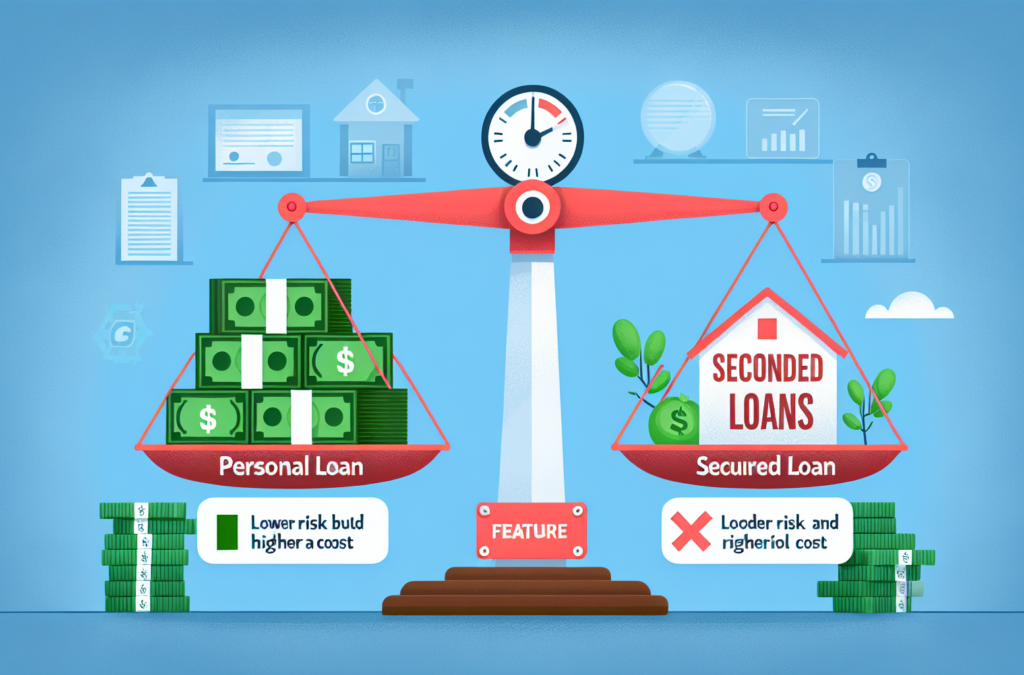
Personal loans and secured loans represent fundamentally different borrowing mechanisms serving distinct needs and carrying contrasting risk profiles. Understanding these differences enables borrowers to select the appropriate loan type based on their specific situation, urgency, asset ownership, and risk tolerance. While personal loans prioritize speed and flexibility, secured loans emphasize lower cost and higher borrowing limits. The optimal choice depends on balancing these factors against individual circumstances and financial objectives.
The fundamental distinction lies in collateral requirements. Personal loans are unsecured, meaning borrowers access funds without pledging any assets—no property, gold, vehicles, or investments serve as security. Approval depends entirely on income stability, credit history, employment type, and demonstrated repayment capacity. In contrast, secured loans require collateral—home loans use property as security, gold loans require gold ornaments, loans against property mortgage real estate, and vehicle loans hold the vehicle as collateral. This asset backing fundamentally alters the lender-borrower risk equation.
Interest rate differences reflect this risk distinction dramatically. Secured loans typically offer rates 4-8 percentage points lower than personal loans. Home loans range from 8-10% annually, gold loans from 8-12%, and loans against property from 9-14%. Personal loans, lacking collateral security, charge 10.50-24% annually. This spread represents the premium borrowers pay for unsecured access to credit. On a ₹10 lakh borrowing, the difference between 9% (secured) and 15% (personal loan) over 5 years amounts to approximately ₹1,75,000 in additional interest—a substantial cost for the convenience and speed of unsecured borrowing.
Loan amounts and loan-to-value ratios differ significantly. Secured loans offer substantially higher borrowing limits because collateral reduces lender risk. Home loans extend up to ₹5 crores or more based on property value. Loans against property provide 50-70% of property market value. Gold loans offer 75% of gold value. Personal loans typically max out at ₹25-40 lakhs, with most borrowers qualifying for far less based purely on income multiples. A borrower earning ₹1 lakh monthly might qualify for a ₹12-15 lakh personal loan but could access ₹50 lakhs through a loan against property if they own real estate.
Approval timelines and documentation requirements vary dramatically. Personal loans, especially through digital lenders, can approve within hours and disburse within 1-2 days. Documentation is minimal—identity proof, income proof, and bank statements suffice. The process is entirely digital for many lenders. Secured loans require extensive documentation and physical processes. Home loans demand property documentation, title verification, legal searches, property valuation, technical assessment, and often take 2-4 weeks from application to disbursal. Loans against property require property valuation and legal verification. Even gold loans, despite being relatively fast, require physical gold verification and purity assessment. This timeline difference makes personal loans attractive for urgent needs despite their higher cost.
Risk profiles differ fundamentally for borrowers. With personal loans, default consequences include credit score destruction, legal proceedings, salary attachment orders, and aggressive collection practices, but borrowers don’t lose physical assets. With secured loans, default leads directly to asset seizure—lenders can legally take possession of mortgaged property, auctioned gold, or repossessed vehicles to recover dues. This represents existential risk; defaulting on a home loan can mean losing your residence, defaulting on a gold loan means losing family heirlooms, and defaulting on a vehicle loan means losing transportation critical for livelihood. The psychological and practical stakes are dramatically higher with secured loans.
Tenure flexibility shows marked differences. Personal loans typically offer 1-7 year tenures. Secured loans provide much longer horizons—home loans extend to 30 years, loans against property to 15-20 years. Longer tenures reduce EMI burden substantially but increase total interest proportionally. The ability to stretch repayment over decades makes large secured borrowings manageable on modest incomes, while personal loans require higher income for equivalent amounts due to compressed repayment periods.
Tax benefits create additional cost differentiation. Home loan interest (up to ₹2 lakhs under Section 24) and principal repayment (up to ₹1.5 lakhs under Section 80C) offer significant tax deductions for salaried individuals. Loans against property for business purposes allow interest deduction as business expense. Personal loans for salaried individuals generally offer no tax benefits, making their post-tax cost even higher. Self-employed individuals can claim personal loan interest as business expense if borrowed for business purposes, but documentation requirements are stringent.
Purpose restrictions differ meaningfully. Secured loans often come with usage restrictions—home loans must be used for property purchase or construction, vehicle loans for vehicle purchase. Violating end-use stipulations can trigger loan recall. Personal loans impose no usage restrictions; borrowers can deploy funds for any legal purpose without justification to lenders. This flexibility justifies personal loan selection even when secured alternatives exist, if the borrowing purpose doesn’t align with secured loan categories.
Prepayment flexibility varies significantly. RBI mandates that floating rate retail loans cannot have prepayment penalties, affecting most home loans and many other secured loans. However, personal loans predominantly carry fixed rates where lenders can legally charge prepayment penalties of 2-5% of outstanding principal, though competitive pressure has led many lenders to eliminate these. The ability to prepay without penalty affects total borrowing cost and should influence loan type selection if you anticipate surplus funds during tenure.
Credit score impact differs in magnitude. Both loan types report to credit bureaus, but secured loans typically involve larger amounts and longer tenures, meaning their impact on credit reports extends over decades. Successfully managing a 20-year home loan builds exceptional credit history. However, default on secured loans creates catastrophic credit damage plus asset loss—a double blow. Personal loans, being shorter and smaller, have condensed credit impact timelines. Perfect repayment of a 3-year personal loan builds good credit history relatively quickly.
The optimal choice framework involves several considerations. Choose personal loans when: you need funds urgently (within 2-3 days), you don’t own assets to pledge as collateral, the loan amount is relatively modest (under ₹10 lakhs), you value unrestricted fund usage, you prefer not to risk asset seizure, and you can afford higher EMI associated with shorter tenure and higher interest. Choose secured loans when: you own assets and are comfortable mortgaging them, you need large amounts (₹25 lakhs+), you prioritize minimizing interest cost over approval speed, you’re comfortable with longer repayment horizons (10+ years), you want to benefit from tax deductions, and you have stable long-term income supporting extended EMI commitments.
Hybrid approaches sometimes offer optimal solutions. Borrowers might take a small personal loan to address immediate urgent needs while simultaneously applying for a secured loan to refinance the personal loan at lower interest once approved. Or they might use personal loans for the gap amount after maximizing secured loan limits. Understanding the distinct characteristics of each loan type, their respective advantages and limitations, and your own financial situation and needs enables informed borrowing decisions that minimize cost while meeting requirements effectively.
Leave a Reply